The Geometric Miracle that Reauthored Argentina’s World Cup Destiny in 2026

Every World Cup champion enters a new tournament burdened by a dangerous, suffocating myth: the illusion of permanence. When Argentina arrived in North America for the FIFA World Cup 2026, they did not just bring a 26-man roster; they brought the colossal, almost mythical weight of their 2022 triumph in Lusail.
For four years, the footballing world had romanticized the Albiceleste as an untouchable, eternal collective. But football is a sport designed to brutalize history. The opening match of a World Cup is notoriously indifferent to past glory, and for 70 agonizing minutes during their first group stage match, Argentina looked like a kingdom on the verge of starvation.
The opposition had built a defensive fortress, a suffocating, hyper-disciplined low block that systematically neutralized Lionel Messi’s pocket of space and strangled the lateral movements of Julian Alvarez. The stadium was a pressure cooker of anxiety. It felt as though the script had already been written: a sluggish, frustrating stalemate to signal the beginning of the end of an era.
Then, in the 74th minute, a moment of pure, geometric sorcery occurred. It was a goal that did not just secure a crucial 1-0 victory; it systematically reauthored how Argentina will play football in the post-perfection era.

The Subversion of the Messi Magnet
You must understand the psychological phenomenon known as the “Messi Magnet.” For over a decade, every single attacking sequence under Lionel Scaloni’s regime followed a predictable, gravitational pull. When Argentina advanced the ball into the final third, every player’s subconscious objective was to find Number 10. The opposition knew this, positioning three defensive midfielders solely to cut off the passing lanes leading to his left foot.
The breakthrough in the 74th minute was beautiful precisely because it deliberately subverted this gravity.
The play began deep in the midfield with Alexis Mac Allister, who received a sharp, vertical pass from Cristian Romero. Standard football logic dictated that Mac Allister would look to lay the ball off to Messi, who was dropping deep into the right half-space, dragging two defenders with him. In previous years, that pass would have been automatic. But in this exact millisecond, Argentina executed their new 2026 tactical evolutionary step.
Instead of feeding the magnet, Mac Allister used Messi’s gravity as a decoy. He turned his hips away from Messi entirely, blind-siding the opposition’s defensive line, and sliced an incredibly sharp, diagonal trivela pass into the half-space on the opposite side of the pitch. It was a complete rejection of the established script, catching the opponent’s defensive block mid-shift.
Spatial Intelligence Over Raw Power
The recipient of Mac Allister’s diagonal laser was Alejandro Garnacho, who had spent the match hugging the left touchline, isolated and patient. The true beauty of what happened next lies in the spatial intelligence of the modern, new-gen Argentina attacking corps.
As the ball traveled across the grass, Lautaro Martinez made a decoy run into the near post, dragging the primary center-back with him and creating a microscopic, two-meter window of space in the center of the penalty area. Garnacho did not control the ball to cross it; he executed a flawless, one-touch cushioned cushion header back into the path of an oncoming runner.
And this is where the new era officially announced its arrival. It wasn’t Messi sprinting into that vacant space. It was Enzo Fernandez, arriving from deep midfield like an absolute freight train.
Enzo didn’t attempt a violent, high-risk laces strike that would risk skying the ball into the packed stands. Operating under immense physical pressure from a recovering defender, he showcased an astonishing level of composure.
He opened his body up completely, leaned slightly backward to alter his center of gravity, and executed a precise, side-footed curling strike that bypassed the goalkeeper’s outstretched hands, clipping the inside of the far post before settling into the net. It was an exercise in pure kinetic economy, spatial intelligence completely triumpthing over raw physical violence.
The Autonomy of the New Generation
The mainstream sports media will inevitably frame this victory as another chapter in the twilight saga of Lionel Messi. But the fresh, uncontested perspective on this specific goal is that it represents the birth of Argentina’s tactical autonomy.
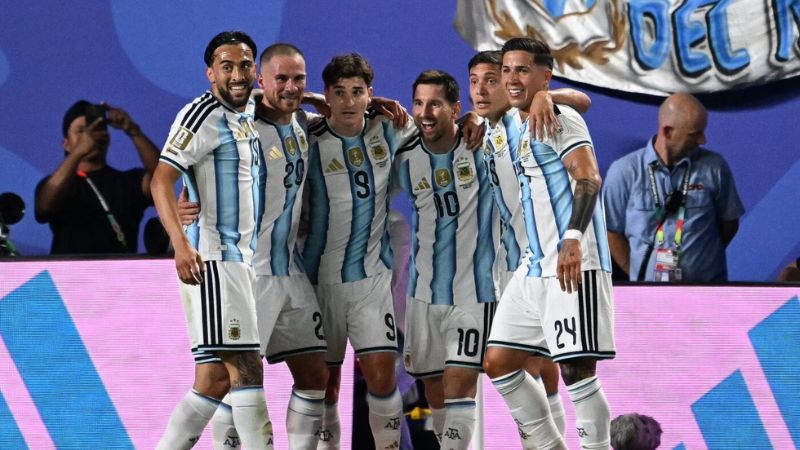
Look closely at the footage of the celebration. When the ball hit the back of the net, Enzo Fernandez did not run toward Messi; he sprinted toward the corner flag, pointing directly at Garnacho and Mac Allister, before being swarmed by his midfield compatriots. Messi arrived last, wrapping his arms around the young midfielders with a look of profound, visible relief on his face.
This goal was the definitive proof that the youth academy of the Albiceleste has grown up. They are no longer just a supporting cast assembled to protect and serve a singular god; they are a self-sustaining, elite unit capable of inventing answers entirely on their own.
The goal was engineered by Mac Allister (27), assisted by Garnacho (21), and finished by Enzo Fernandez (25). This is the exact blueprint Argentina required to stay alive in a grueling, expanded 48-team tournament. By proving they can unlock elite international defenses without Messi touching the ball in the final third, they have made themselves twice as unpredictable and twice as terrifying to game-plan against.
The Tectonic Shift in the World Cup Narrative
A 1-0 opening victory is a quiet result on paper, but tactically, it is a seismic warning shot to the rest of the tournament contenders in North America. It shattered the illusion that Argentina is a nostalgic, aging team hanging onto the remnants of their Qatari fairy tale.
By winning their opening match through a sequence defined by spatial subversion, generational autonomy, and cold-blooded mechanical efficiency, Scaloni’s men have successfully shed the skin of the defending champions. They have transitioned from a team protecting a legacy to a team actively hunting a new one.
The road to the final in New York is impossibly long, and the challenges will only grow more complex. But as the echo of that 74th-minute strike continues to resonate through the tournament, one thing is undeniably clear: Argentina’s future has officially caught up to its present, and the throne will not be surrendered easily.