How Meccha Chameleon Proved That Pure Mechanical Creativity Beats a Multi-Million Dollar Marketing Budget

There is a growing sense of exhaustion in the modern video game industry. We are regularly bombarded by massive, corporate-backed blockbusters that cost $300 million to make, take six years to develop, and require a $70 entry fee just to get through the title screen. These games arrive wrapped in months of carefully calculated marketing campaigns, cinematic trailers, and high-profile celebrity sponsorships. Yet, time and time again, they launch as bloated, sterile experiences that feel more like a product of a board meeting than a labor of love.
Then, out of absolute nowhere, a game like Meccha Chameleon arrives and completely shatters the rulebook.
Developed in just two months by a duo of Japanese indie creators, lemorion_1224 and Haganeiro, this tiny, unassuming title launched on Steam with zero traditional marketing budget. It didn’t have billboard ads in Times Square, nor did it have a million-dollar live-action cinematic trailer. What it did have was a brilliant, ridiculously simple core mechanic and a price tag cheaper than a fancy cup of coffee.
The result? It exploded into the biggest viral sensation of the year, selling a staggering 10 million copies in just over two weeks and comfortably sitting at the top of the global Steam charts, leaving massive, hyper-marketed titles eating its digital dust.
Meccha Chameleon didn’t just succeed; it staged a tactical coup against the entire philosophy of corporate gaming. It proved that when you give players pure, unadulterated mechanical creativity, you don’t need a multi-million dollar marketing apparatus to change the world.
The Genius of High-Stakes Digital Camouflage
At its heart, Meccha Chameleon is just a digital game of hide-and-seek. Up to 24 players load into a map, split into two teams: Hunters and Chameleons. If you are a Seeker, your job is simple—find and swat the hiders before the timer runs out. But if you are a Chameleon, the game transforms into a chaotic, hilarious blend of tactical stealth and impromptu graphic design.
You start each round as a completely blank, bipedal white blob. To survive, you cannot just duck behind a box and hope for the best. Instead, you have to actively paint your own body to perfectly mimic whatever part of the environment you are touching.
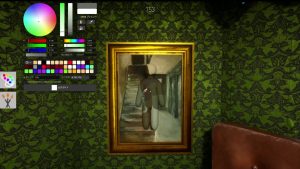
The game arms you with fundamental image-editing tools: a 3D eyedropper, a color picker, and fine-tuning sliders for HSV values, metallic properties, and surface roughness. If you want to hide against a rusted iron pipe in a sewer map, you can’t just turn gray; you have to match the exact shade of rust, match the texture glare using the roughness slider, and assume a physical pose—like curling up into a ball or lying flat on your face—to break up your character’s silhouette.

This creates a brand-new kind of gaming skill gap. Meccha Chameleon doesn’t care about your lightning-fast first-person shooter reflexes or your complex tactical strategies. Instead, it tests whether your fight-or-flight response will completely compromise your ability to use a color wheel while a hunter walks down the hallway outside your room.
There is a deeply humbling, distinct comedy to the gameplay loop. You will spend a frantic 30 seconds perfectly replicating the geometric patterns of a mansion’s wallpaper, confident that you have pulled off a masterclass in modern espionage. You freeze in place, hold your breath, and watch a hunter walk right past you. You start to celebrate, only to realize that you completely forgot to account for your dynamic shadow, or that your roughness settings are too high, making your character reflect light like a freshly polished sports car. Your own graphics settings literally betray you, resulting in a sudden panic as you scramble to run away while looking like a walking piece of living room decor.
Designed for Chaos and Built for Streamers
The explosion of Meccha Chameleon wasn’t an accident, but it also wasn’t bought. It succeeded because its core mechanics are inherently dramatic and intensely watchable.
In the modern media landscape, the best marketing campaign is a live audience. The developers designed the game to run seamlessly on Epic Online Services, allowing public and private lobbies to form effortlessly. Crucially, they built the game to welcome content creators. When a popular streamer hosts a lobby, the tension is palpable. Viewers aren’t just watching a player aim a crosshair; they are watching a player actively engage in a high-stakes psychological game against other human beings.
The game features built-in mechanics that seem tailored to create viral moments. Chameleons can deliberately whistle or taunt to drop an audio cue for the hunters, sparking a terrifying game of hot-and-cold. When a streamer is hidden perfectly as a step on a staircase, and a hunter stands directly on top of them without realizing it, the comedic tension is gold. It screams to be clipped, shared on TikTok, and passed around on social media.
This organic word-of-mouth engine is something a corporate marketing team cannot buy. A publisher can spend $50 million on unskippable YouTube ads, but it will never match the raw conversion power of seeing your favorite gaming community screaming in collective terror because someone successfully convinced another human being that they were a bathroom tile.
The Power of Low-Spec Accessibility
Another massive hurdle that Meccha Chameleon cleared with ease was accessibility. While modern AAA titles demand that players own a top-of-the-line console or a liquid-cooled PC gaming rig that costs thousands of dollars, this game runs smoothly on modest hardware. The developers even went a step further by securing a launch on cloud platforms like GeForce NOW, ensuring that anyone with a basic laptop or a Mac could join the fun.
By lowering both the financial barrier and the technical barrier, the game became universal. It isn’t just a game for “hardcore gamers.” It’s a party game that groups of friends buy on a whim on a Friday night because it costs less than a fast-food meal. When a game is that accessible and that immediately entertaining, its growth becomes exponential. You don’t buy it because an ad told you to; you buy it because five of your friends are currently in a Discord call losing their minds, and you don’t want to be left out.
Infinite Replayability Through the Community
What transforms Meccha Chameleon from a fun weekend distraction into a dominant, long-term cultural fixture is its reliance on the community via the Steam Workshop.
While the official maps like the Hide-and-Seek Mansion, the Sewer, and Osaka are incredibly well-designed, players naturally learn the layouts over time. Once a hunter memorizes where every single pipe, painting, and piece of furniture is supposed to be, the chameleons face a steep disadvantage.
Enter the modding community. By opening the game up to user-generated content, the developers unlocked infinite replayability. Within days of launch, the Steam Workshop was flooded with thousands of custom, player-made maps. You can hide in a replica of Bikini Bottom, sneak through a giant-sized Minecraft house, or attempt to blend into a literal fine art gallery where every wall is covered in intricate, colorful paintings.
This relationship between the community and the developers keeps the game fresh every single day. It removes the burden of constant content updates from the small dev team and hands the keys to the players. Every time you log in, you can experience a completely different visual landscape, forcing you to relearn how to hide all over again. It’s a brilliant symbiosis that expensive, live-service games with seasonal battle passes try to manufacture but rarely achieve with this level of genuine joy.
The Lesson the Gaming Industry Needs to Learn
The staggering success of Meccha Chameleon is a loud, clear wake-up call to the wider video game industry. It serves as undeniable proof that players are growing tired of polished, uninspired corporate products that prioritize monetization models over mechanical fun.
A game doesn’t need a massive development pipeline, a studio of five hundred people, or an aggressive promotional campaign to capture the hearts of millions of players. It needs a single, great hook that is executed with joy, simplicity, and a deep understanding of human interaction. It needs to give players a canvas to be creative, a space to laugh with their friends, and a loop that feels rewarding every single time they play.
Meccha Chameleon stripped away all the bloat, handed us a digital paint brush and a color wheel, and asked us to play hide-and-seek. In doing so, it delivered the most engaging, hilarious, and genuinely valuable gaming experience of the year—proving that real mechanical creativity will always triumph over a multi-million dollar marketing budget.